
Custom vs semi-custom cabinets: where is the real difference?
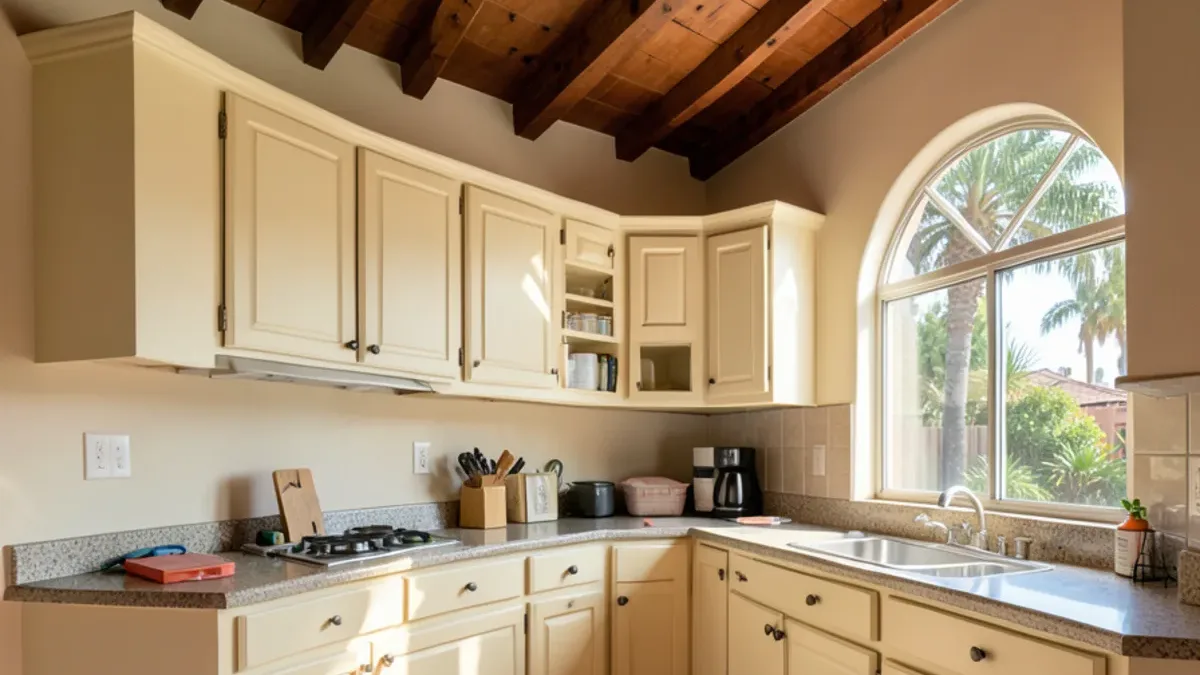
All three tiers can use good materials, and all three can be built poorly. What changes from tier to tier is how much of the cabinet can be changed to suit your kitchen: width, depth, height, door style, finish, interior fittings and the small pieces such as panels and moldings that make a run look built in.
Box construction is a separate decision. Plywood, MDF and particleboard appear across tiers, so ask what the box is made of regardless of label. Our guide to plywood, MDF and particleboard boxes covers that choice.
Want to see the options in person?
The Sherman Way showroom has cabinets, counters, tile and flooring on display side by side. Call before you come and say what you're working on.
- Showroom at 13259 Sherman Way, North Hollywood
- 20 Google reviews
- BBB rating A+
- Cabinets, counters, tile & floors in one place
How do stock, semi-custom and custom compare side by side?
| Feature | Stock | Semi-custom | Custom |
|---|---|---|---|
| Widths | Set increments, usually every 3 inches | Standard widths plus modified sizes | Any dimension |
| Depth and height changes | Rarely | Common options | Built to suit |
| Door styles and finishes | A short list | A wide range of doors, paints and stains | Nearly anything, including matching an existing color |
| Interior fittings | Basic shelves and drawers | Many pull-outs and organizers | Fully tailored |
| Relative lead time | Shortest | Medium | Longest |
| Relative cost | Lowest | Middle | Highest |
When are stock cabinets the smart choice?
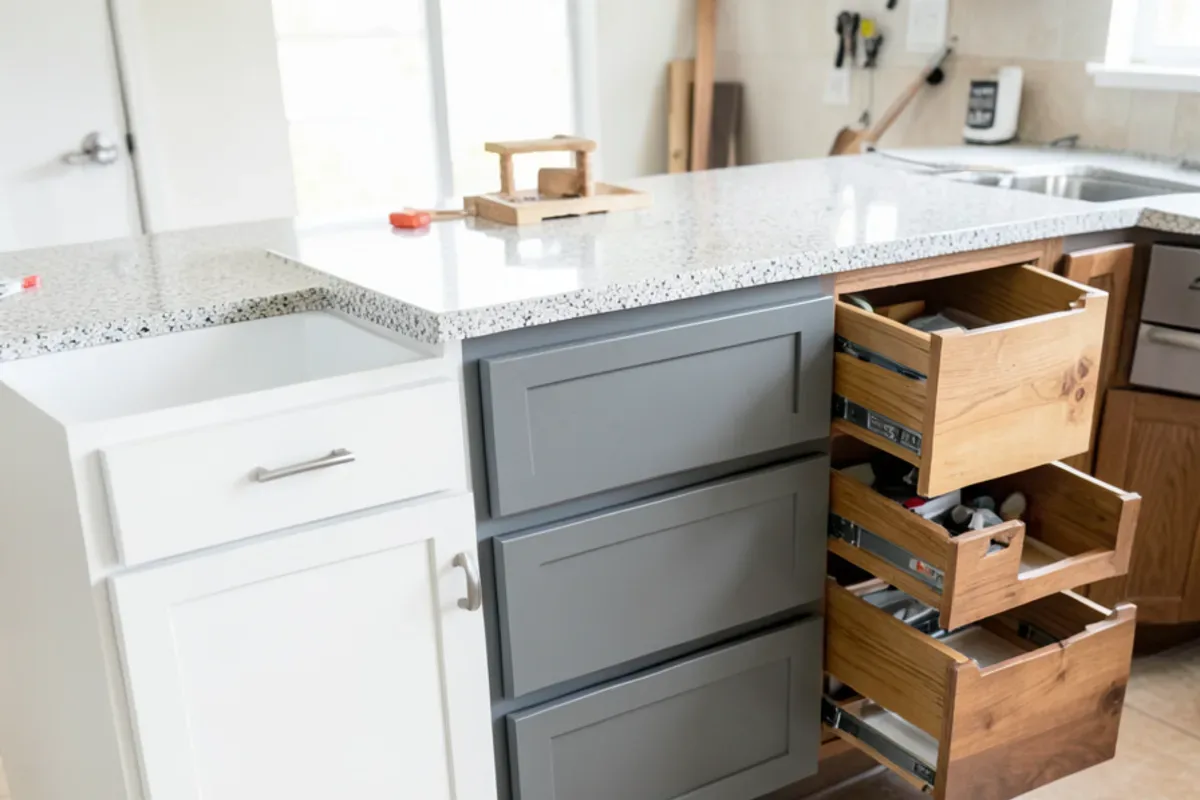
Stock lines make sense when speed and budget matter more than a perfect fit: rental turnovers, ADUs, garage and laundry storage, or a straightforward kitchen with standard ceiling height and square walls. Fillers close the gaps where the room does not divide neatly into standard widths. The trade-off is less control over finish and fewer specialty sizes.
Stock does not have to look basic. A clean Shaker or slab door in a neutral color, a good countertop and a well-chosen backsplash carry most of the visual weight in a kitchen. Where stock lines fall short is in the details: an end panel that does not quite match, a run that needs a wide filler beside the range, or uppers that stop well short of a tall ceiling. If those details bother you, it is usually a sign to step up a tier for the main run rather than the whole kitchen.
Why does semi-custom suit so many Los Angeles kitchens?
Semi-custom cabinetry covers most of what a family kitchen needs: a range of door styles and colors, reduced-depth boxes for a tight aisle, taller uppers for higher ceilings, and organizers inside. It handles the typical condo, tract home and ranch house well, at less cost and with a shorter wait than full custom.
- Reduced-depth base or wall cabinets to open up a narrow galley
- Taller uppers to reach the ceiling once a soffit comes down
- Finished end panels and matching moldings on an island
- Drawer stacks, pull-out trash and tray dividers chosen per box
The semi-custom cabinets page shows the options in more detail.
Which houses really call for custom cabinetry?
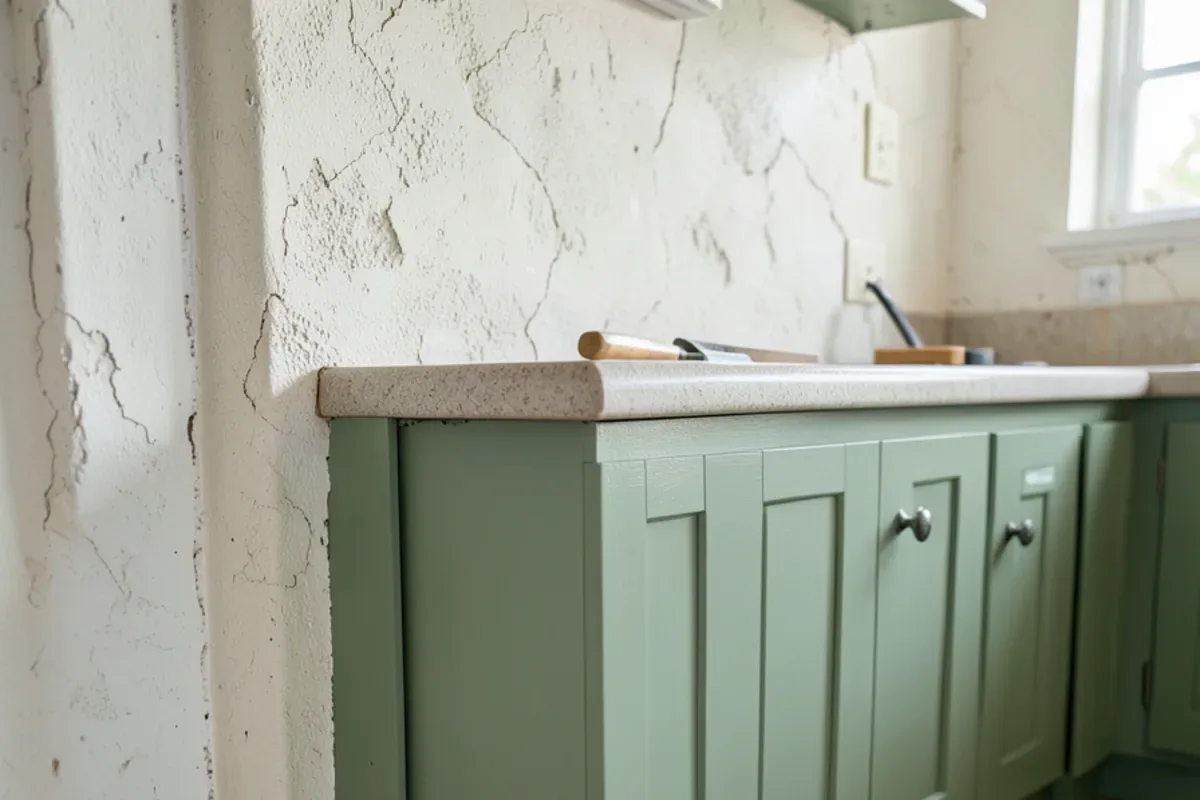
Custom work pays off when the room itself is irregular. Many 1920s and 1930s bungalows and Spanish-style homes around Los Angeles and Burbank have walls that are out of plumb, ceilings that change height, or window placements that leave odd widths. Hillside houses may have angled walls or split levels. In those rooms, fillers look like patches, and built-to-measure boxes look like they belong.
- Out-of-square corners and walls that bow or lean
- Built-ins that continue into a dining room or butler’s pantry
- Matching an existing period cabinet or a specific paint color
- Unusual appliance panels or furniture-style pieces
If any of those describe your kitchen, start with the custom kitchen cabinets page.
How does each tier cope with crooked walls and floors?
Very few Los Angeles kitchens are perfectly square, level and plumb, so every installation absorbs some error. The tiers differ in where that error goes. Knowing the fixes helps you judge whether your room really needs custom boxes or just a careful installer.
| Room problem | Stock answer | Semi-custom answer | Custom answer |
|---|---|---|---|
| Run length does not divide into standard widths | Fillers at walls and appliances | Modified box widths with small fillers | Boxes built to the exact length |
| Wall leans or bows | Scribe a filler or panel to the wall | Wider scribe strips ordered with the run | Scribe allowance built into the end stiles |
| Floor slopes along the run | Shims under the boxes; toe-kick trimmed | Shims or adjustable legs; scribed toe-kick | Same, sometimes with a taller toe-kick planned in |
| Ceiling height changes across the room | Uppers stop at one height; crown hides the gap | Taller or stacked uppers to suit | Uppers sized to each section of ceiling |
| Window or doorway leaves an odd gap | Open shelf or filler | Modified-width box | Box sized to the opening |
Custom work also changes the measuring. Built-to-measure boxes are usually measured after drywall and framing are finished, so the dimensions reflect the real room, which pushes the order later in the project. Stock and semi-custom runs can be ordered from a measured plan earlier, with fillers absorbing small differences.
Looking past the door: what the display boxes reveal
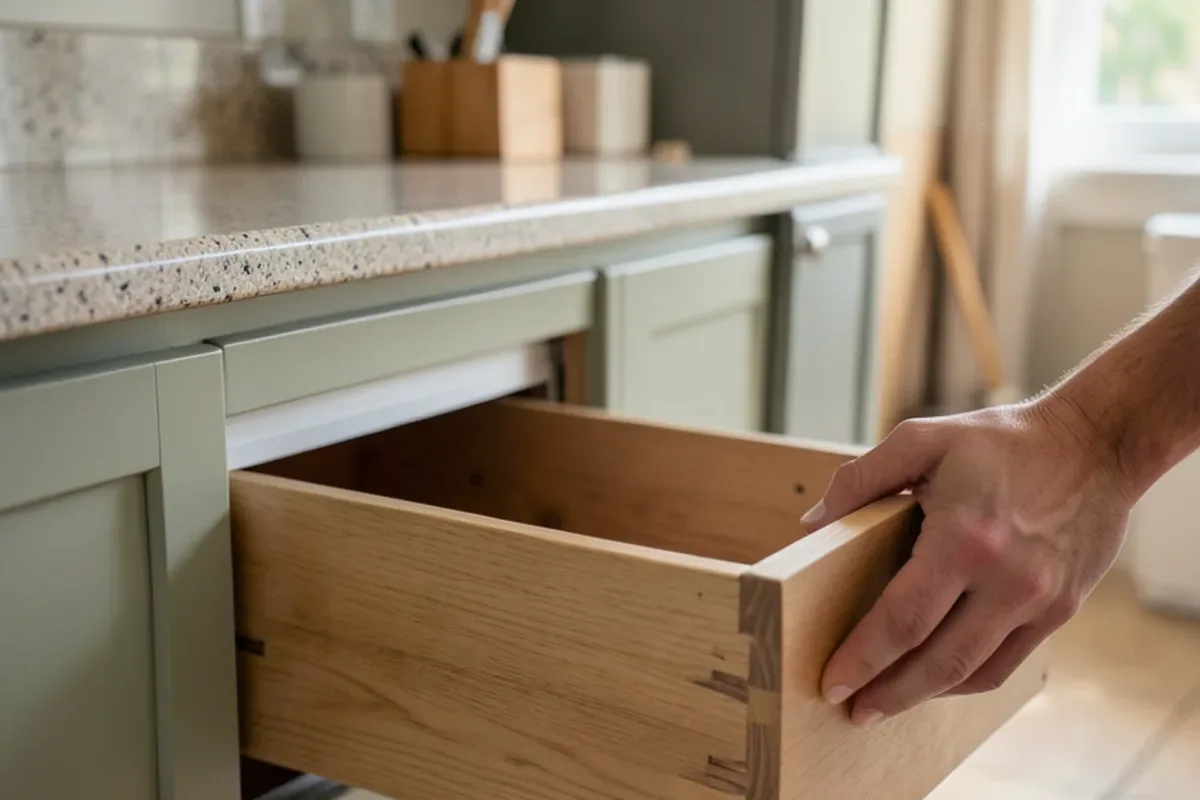
Door samples get the attention in any cabinet showroom, but the box tells you more about the tier. On the Sherman Way floor, framed and frameless cabinets in several lines sit close enough to compare directly, and a few minutes with the drawers open says a lot.
- Pull each drawer fully out. Check whether it extends all the way and closes softly.
- Look at the drawer box joints and bottom thickness.
- Open a door and look at the hinge adjustment and the inside finish of the box.
- Check the finished end panel; that is what people see on an island.
- Ask which options are available per box, not just per line.
Mixing tiers is common too. A semi-custom main run with one custom piece, such as an angled corner unit or a built-in desk, often gives the look of a fully custom kitchen at a lower cost.
Questions that settle the tier quickly
When a kitchen could go either way, a short set of questions usually decides it:
- Is there a dimension you cannot change, such as a window, a chimney breast or a fixed appliance? If several, custom moves up the list.
- Is the move-in or rental date fixed? Longer production for custom boxes can be the deciding factor.
- Do you need to match an existing built-in or a specific color? Semi-custom paint programs cover many colors; exact matches lean custom.
- Where will the money show? An island seen from the living room may deserve the upgrade more than a laundry-room run.
There is a quieter trade-off too. A damaged stock or semi-custom door can usually be reordered from the line, while a custom door is remade to order, with the same production wait as the original. Some cabinet lines also carry KCMA certification, a third-party test of structural strength and finish durability under the ANSI/KCMA A161.1 standard, which is a useful data point in any tier.
Choosing your cabinet tier
Measure the room, note anything out of square, and decide how soon you need the cabinets. Then compare tiers in person: browse semi-custom cabinets, see custom kitchen cabinets for irregular rooms, or start with the full kitchen cabinets collection, including local and imported lines.
Quick answers
Can stock, semi-custom and custom cabinets be mixed in one kitchen?
Yes, and it is a common way to manage cost. A kitchen might use stock or semi-custom boxes for the main runs and one custom piece for an awkward corner or built-in. The key is matching door style, finish and overlay across lines, so compare samples together before ordering, ideally under the same light.
Is semi-custom cabinetry lower in quality than custom?
Not necessarily. Semi-custom and custom differ mainly in how much can be changed, not in how well they are built. A semi-custom line with plywood boxes and full-extension soft-close drawers can outperform a poorly built custom job. Judge construction directly: box material, drawer joints, hinges and finish quality.
What are fillers, and when do stock cabinets need them?
Fillers are narrow strips that close gaps between cabinets and walls when a run does not add up to standard widths, which usually come in 3-inch steps. A small filler next to a wall also lets doors and drawers clear handles and trim. Large fillers in many places can look patched, which is when semi-custom sizing helps.
Do custom cabinets add resale value in Los Angeles?
They can add appeal, but buyers rarely pay for the tier itself. What they notice is fit, finish and storage, which a well-planned semi-custom kitchen also delivers. Custom makes the strongest case in period homes, where cabinetry that fits the architecture helps the house feel original, and in rooms too irregular for standard boxes.
Sources
- Kitchen Cabinet Manufacturers Association (KCMA) — Cabinet construction and performance standards
- National Kitchen & Bath Association (NKBA) — Kitchen planning guidelines
- Contractors State License Board (CSLB) — C-6 cabinet and millwork license lookup
About this guide
Written by the team at Adcom Kitchen & Flooring, a kitchen cabinet, countertop, tile and flooring showroom at 13259 Sherman Way in North Hollywood. Rules and figures from outside sources are attributed; confirm current requirements with your building department or the agency named.
Service areas
More on this topic: Kitchen Cabinets
Talk to the showroom before you buy
Call with your measurements and photos, or stop by Sherman Way to compare cabinets, counters, tile and flooring side by side.
Adcom Kitchen & Flooring · 13259 Sherman Way, North Hollywood, CA 91605 · Get directions · Showroom hours
- Showroom at 13259 Sherman Way, North Hollywood
- 20 Google reviews
- BBB rating A+
- Cabinets, counters, tile & floors in one place