
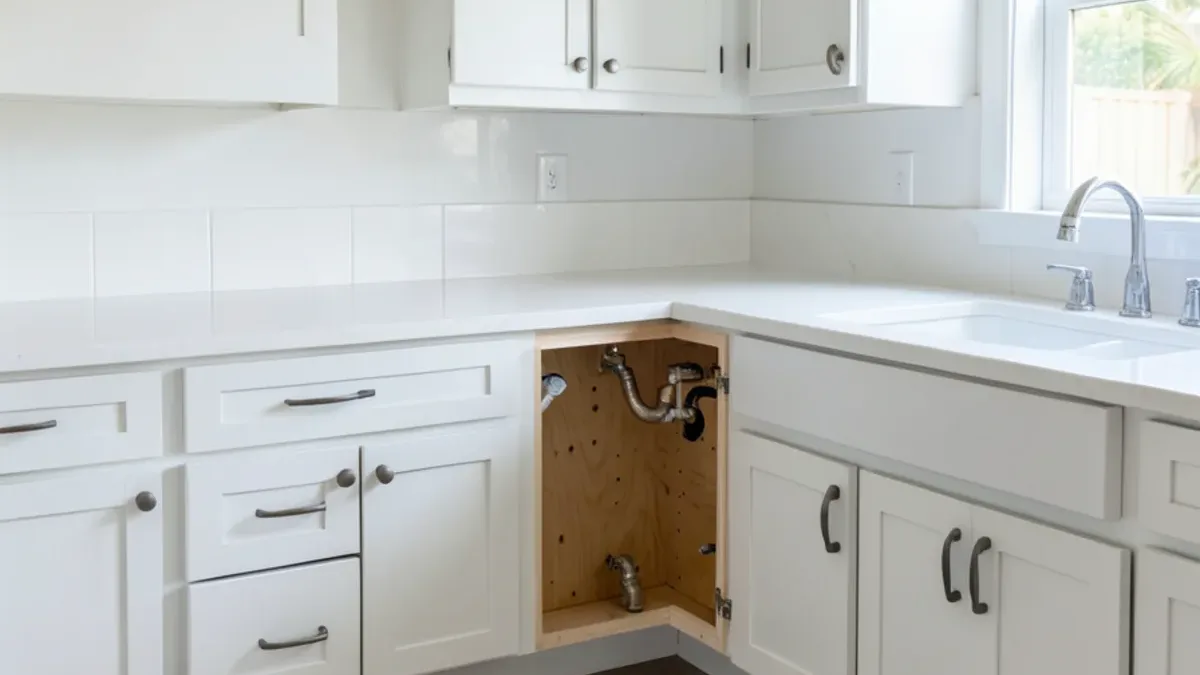
Plywood vs MDF cabinets: how are the materials made?
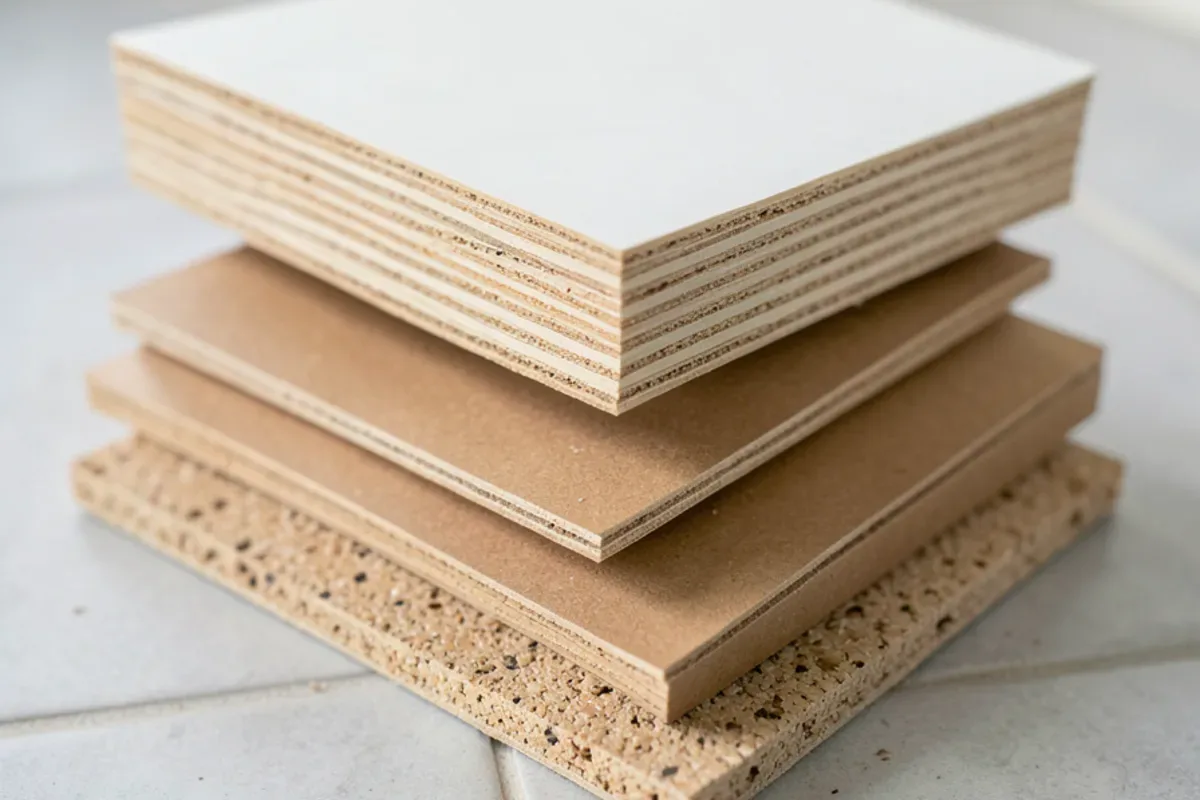
Plywood is built from thin wood veneers glued in layers with the grain alternating, which gives it strength in every direction and good screw-holding. MDF (medium-density fiberboard) is made from fine wood fibers and resin pressed into a dense, uniform sheet with no grain. Particleboard uses larger wood chips and resin, pressed into a lighter, less dense board that is usually covered with melamine or laminate.
Cabinet lines combine them in different ways. A box might have plywood sides and a particleboard back, or a melamine-faced particleboard box with MDF doors. Read the specification for sides, bottom, back, shelves and drawer boxes separately.
Thickness and grade matter as much as the material name. A thin, low-grade plywood with voids in its inner layers can perform worse than a thick, dense MDF panel, and a 3/4-inch side holds hinges and shelf pins far better than a 1/2-inch one. When two lines both say plywood, ask how thick the sides are and what the face veneer is.
Want to see the options in person?
The Sherman Way showroom has cabinets, counters, tile and flooring on display side by side. Call before you come and say what you're working on.
- Showroom at 13259 Sherman Way, North Hollywood
- 20 Google reviews
- BBB rating A+
- Cabinets, counters, tile & floors in one place
How do plywood, MDF and particleboard compare?
| Property | Plywood | MDF | Particleboard |
|---|---|---|---|
| Screw and hinge holding | Strong, including near edges | Good on faces, weaker at edges | Weakest; screws can strip |
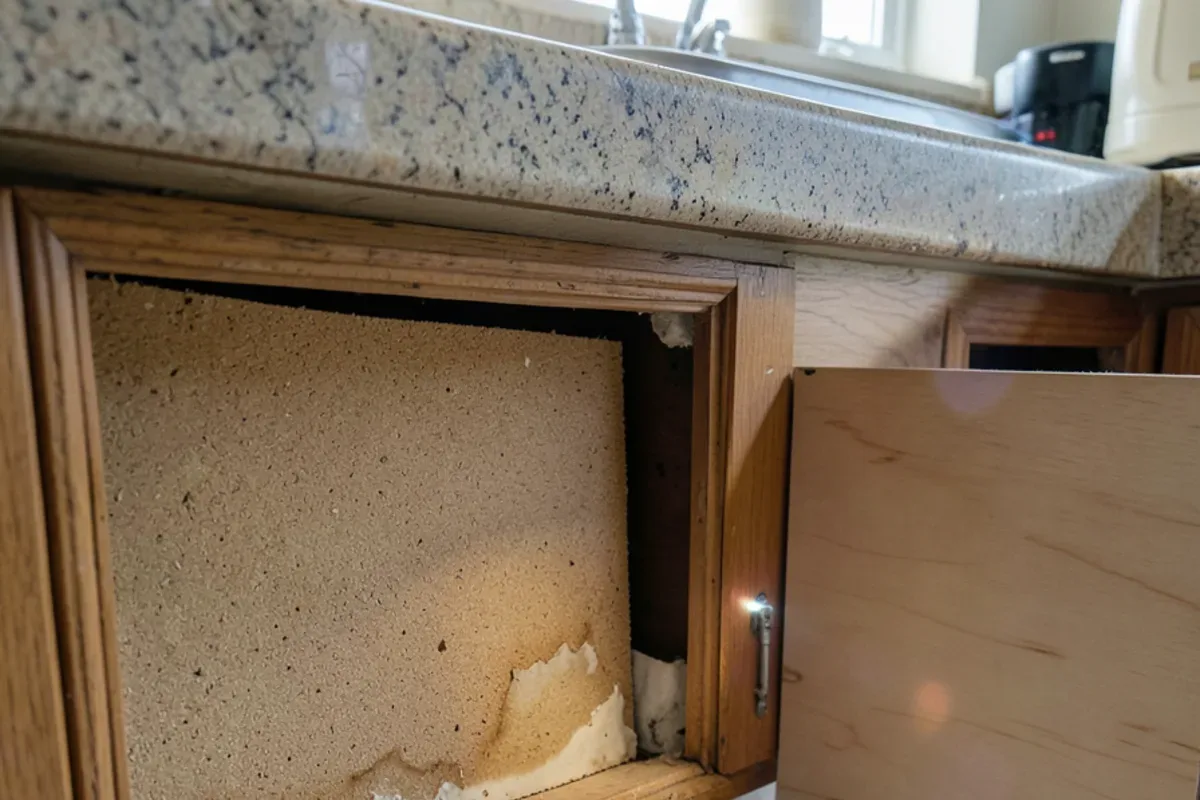
| Response to a leak | Resists swelling longest | Edges swell and stay swollen | Swells and crumbles fastest |
| Surface for paint | Grain can telegraph through paint | Very smooth, ideal for paint | Usually covered with melamine instead |
| Dimensional stability | Good | Very good | Good when sealed |
| Weight | Lightest of the three for a given strength | Heaviest | Moderate |
| Relative cost | Highest | Middle | Lowest |
Where does each material belong in a kitchen?
- Sink base and dishwasher neighbors: plywood, because a slow supply-line drip or a failed dishwasher seal is a matter of when, not if.
- Painted Shaker or slab doors: MDF center panels or full MDF doors stay flat and smooth, without the seasonal crack a painted solid-wood panel can show at its joint.
- Wall cabinets in dry locations: a well-made particleboard or MDF box is acceptable on a tight budget.
- Shelves: thicker plywood resists sagging under dishes better than thin particleboard.
- Drawer boxes: solid wood or plywood drawers last longer under heavy pots than particleboard.
Mixing is often the smart answer: a plywood sink base in an otherwise standard kitchen, or plywood boxes with MDF painted doors. Our kitchen cabinets page shows how construction options differ between lines, and custom kitchen cabinets let you specify the material box by box.
Beyond the panel: joints, backs and hanging rails
Two cabinets made of the same material can behave very differently because of how they are put together. The panel is only half of the story; these details decide whether a box stays square for years:
| Detail | Sturdier version | Weaker version | Why it matters |
|---|---|---|---|
| Side-to-bottom joint | Dadoed (grooved) and glued, often with screws | Butt joint held by staples or cam-lock fittings | Grooved joints resist racking when the box is moved or loaded |
| Back panel | Full-thickness back or a solid hanging rail | Thin back panel stapled on | Wall cabinets hang by their back or rail; it carries the dishes |
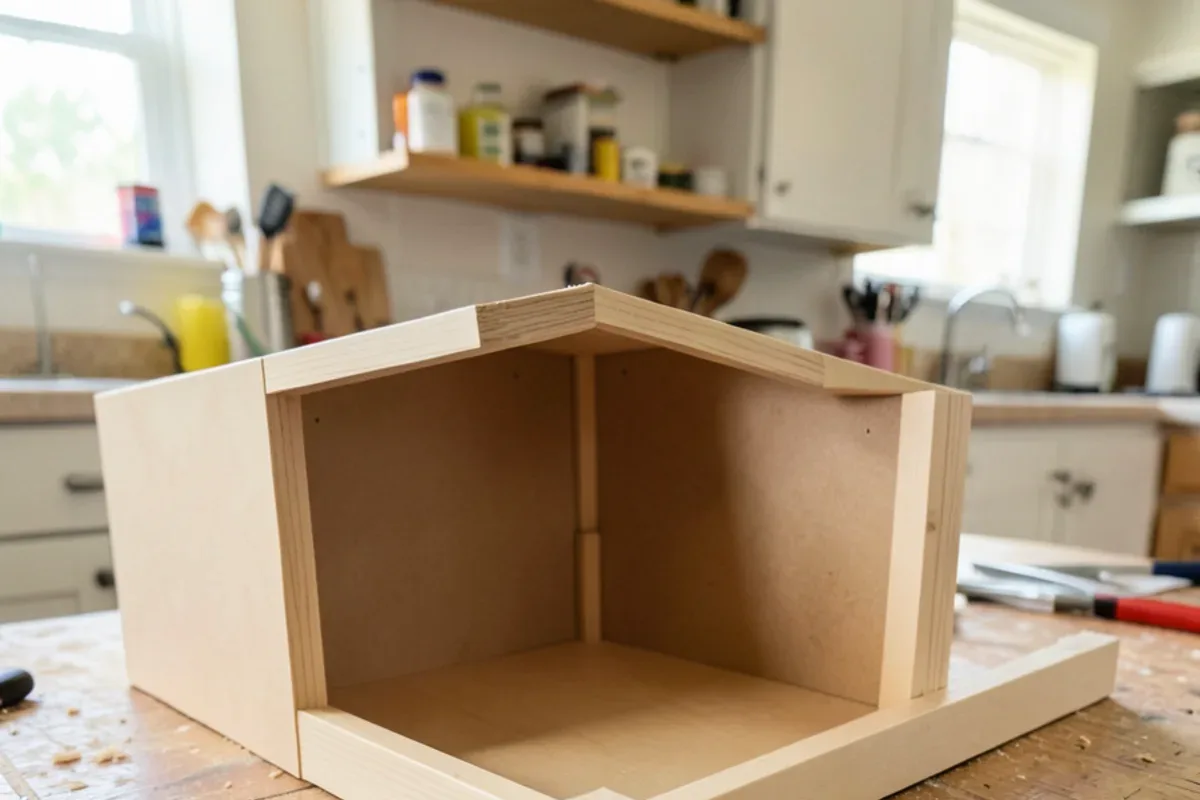
| Base cabinet corners | Corner blocks or gussets | Nothing behind the face frame | Blocks keep the box square while it is leveled and shimmed |
| Drawer box | Dovetailed or doweled solid wood or plywood | Stapled particleboard | Drawers take the hardest daily use in a kitchen |
| Edge banding on melamine | Thick PVC banding, edges sealed | Thin paper banding | Banding is the first line of defense against water at an edge |
Ready-to-assemble boxes with cam-lock fittings can be perfectly serviceable once installed, but they depend on careful assembly and are less forgiving if a box is ever removed and reinstalled. Factory-assembled boxes with glued joints arrive square.
Do formaldehyde rules apply to cabinet materials?
Yes. MDF, particleboard and hardwood plywood are composite wood products, and California’s Air Resources Board (CARB) limits their formaldehyde emissions. The EPA’s national standard under the Toxic Substances Control Act, Title VI, is modeled on the California rule. Compliant panels and finished goods carry labeling showing they meet the standard. If indoor air quality is a priority, ask whether a line uses no-added-formaldehyde or ultra-low-emitting panels.
What changes in bathrooms and laundry rooms?
Humidity and splashing make box material matter even more. A vanity next to a shower, or a laundry cabinet above a washer, sees moisture daily. Plywood or a well-sealed melamine box with sealed edges is the safer choice, and toe-kicks in tile floors should be protected from mop water. In older homes in Pasadena and across Los Angeles, where plumbing may be decades old, a moisture-tolerant sink cabinet is cheap insurance against a hidden drip.
Reading a cabinet box at the display: a few quick checks
A minute with an open cabinet tells you most of what a spec sheet does. These are the checks worth making on the Sherman Way showroom floor, or anywhere else you compare cabinets: Bring a photo of the inside of your current sink base to the visit; it shows at a glance how your existing boxes have coped with water.
- Look at an exposed edge. Plywood shows thin layers; MDF looks like dense cardboard; particleboard shows visible chips.
- Check the side panel thickness and whether the back is a full panel or a thin sheet.
- Press down on the middle of a shelf to see how much it flexes.
- Slide a drawer open and check how its corners are joined and how thick its bottom is.
- Ask what the sink base is made of in the line you prefer, and whether a plywood upgrade is offered for that box alone.
When the plywood upgrade is not worth it
Plywood is the safe answer at the sink, but specifying it everywhere is not always the best use of the budget. An honest read from the cabinet floor:
- Dry wall cabinets away from the sink and dishwasher rarely see the water that separates plywood from a good melamine box.
- Drawer glides and hinges often affect daily satisfaction more than the box core. If money is tight, full-extension soft-close drawers may be the better upgrade.
- Thin or void-filled plywood is not automatically better than a thick, dense MDF or particleboard panel. Compare thickness and quality, not just the label.
- A cheap leak alarm under the sink protects any box material. A battery water sensor on the cabinet floor catches a drip long before particleboard swells.
Specifying boxes for your kitchen
Decide where water is likely, where paint quality matters, and where budget can stretch. Then compare lines on the kitchen cabinets page, consider custom kitchen cabinets if you want to choose materials box by box, and see water-damaged cabinets if a leak is what started the project.
Quick answers
Is MDF a good material for painted cabinet doors?
Yes, it is one of the best. MDF has no grain to show through paint and does not expand and contract the way solid wood panels do, so painted Shaker and slab doors stay smooth and free of joint cracks. Its weak point is water at an exposed edge, so wipe spills promptly, especially on the sink and dishwasher doors.
Will particleboard cabinets hold up in a rental kitchen?
They can in dry areas, with care at the sink. Melamine-faced particleboard is affordable and easy to clean, which suits many rentals. The risk is water: one slow leak can ruin a sink base. Many landlords pair particleboard wall cabinets with a plywood sink base and check under the sink at every turnover.
Are plywood cabinet boxes lighter or heavier than MDF?
Lighter. MDF is denser, so a full MDF box weighs noticeably more than a plywood one of the same size. That matters for upper cabinets, which must be screwed into studs, and for delivery up stairs in hillside homes or condos. Weight alone does not indicate quality, so look at construction and material grade too.
Do cabinets sold in California have to meet formaldehyde limits?
Yes. Composite wood panels such as MDF, particleboard and hardwood plywood must meet California Air Resources Board emission limits, and the federal EPA rule under TSCA Title VI applies nationwide. Look for compliance labeling on the product or packaging, and ask about no-added-formaldehyde panels if you want lower emissions.
Is a thermofoil door over MDF a good choice?
It can be, for the right spot. Thermofoil is a vinyl film heat-formed over an MDF core, giving a smooth, seamless and easy-to-wipe door at a moderate price. Its weakness is heat: doors beside an oven, a range without enough clearance or a toaster that sits under an upper can see the film lift or discolor. Ask whether heat shields are recommended for those positions, and keep painted or wood doors in mind for the hottest spots.
Sources
- California Air Resources Board, Composite Wood Products Program — Formaldehyde limits for MDF, particleboard and hardwood plywood
- US EPA, Formaldehyde Emission Standards for Composite Wood Products — TSCA Title VI national standard
- Kitchen Cabinet Manufacturers Association (KCMA) — Cabinet construction and performance standards
About this guide
Written by the team at Adcom Kitchen & Flooring, a kitchen cabinet, countertop, tile and flooring showroom at 13259 Sherman Way in North Hollywood. Rules and figures from outside sources are attributed; confirm current requirements with your building department or the agency named.
Service areas
More on this topic: Kitchen Cabinets
Talk to the showroom before you buy
Call with your measurements and photos, or stop by Sherman Way to compare cabinets, counters, tile and flooring side by side.
Adcom Kitchen & Flooring · 13259 Sherman Way, North Hollywood, CA 91605 · Get directions · Showroom hours
- Showroom at 13259 Sherman Way, North Hollywood
- 20 Google reviews
- BBB rating A+
- Cabinets, counters, tile & floors in one place