
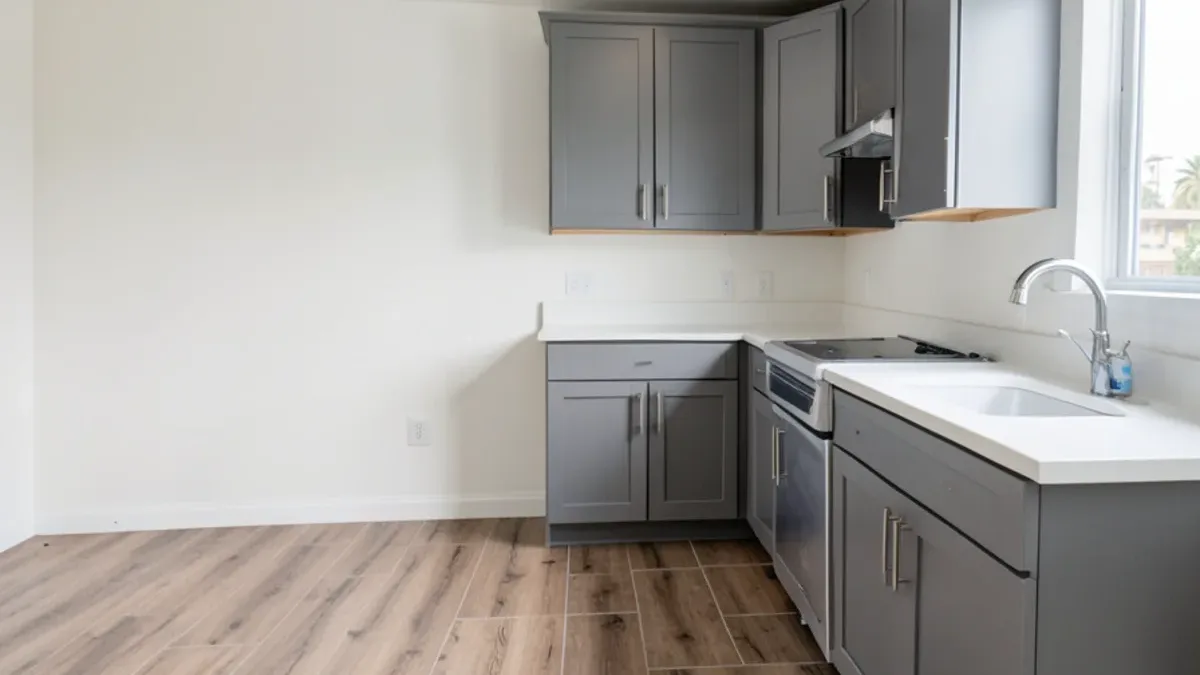
Which rental property flooring survives tenant after tenant?
A rental floor is judged on three things: how it handles water, how it hides wear between turnovers, and how cheaply one damaged area can be fixed. Here is how the usual options compare.
| Floor | Water tolerance | Hides wear | Spot repair | Turnover notes |
|---|---|---|---|---|
| Waterproof vinyl plank | High; core does not swell | Good in mid-tones with grain variation | Easy; replace planks | Fast installation over most flat subfloors |
| Porcelain or wood-look tile | Very high | Very good | Harder; matching tile must be on hand | Long life; grout needs sealing |
| Laminate | Low to moderate | Good | Moderate | Swells at edges after standing water |
| Carpet | Low; pad absorbs spills | Fair | Patch or replace the room | Low cost per room; common in bedrooms |
| Solid hardwood | Low | Shows scratches | Refinish the room | Better suited to long-term owner-occupied homes |
The waterproof vinyl flooring page explains wear layers and core types, the two details that separate a plank that lasts several tenancies from one that dents under the first sofa.
Want to see the options in person?
The Sherman Way showroom has cabinets, counters, tile and flooring on display side by side. Call before you come and say what you're working on.
- Showroom at 13259 Sherman Way, North Hollywood
- 20 Google reviews
- BBB rating A+
- Cabinets, counters, tile & floors in one place
What makes a rental kitchen cheap to keep running?
Kitchens generate most repair calls in a rental, and nearly all of them start at the sink. Spend where water and heat hit hardest, and save on everything else.
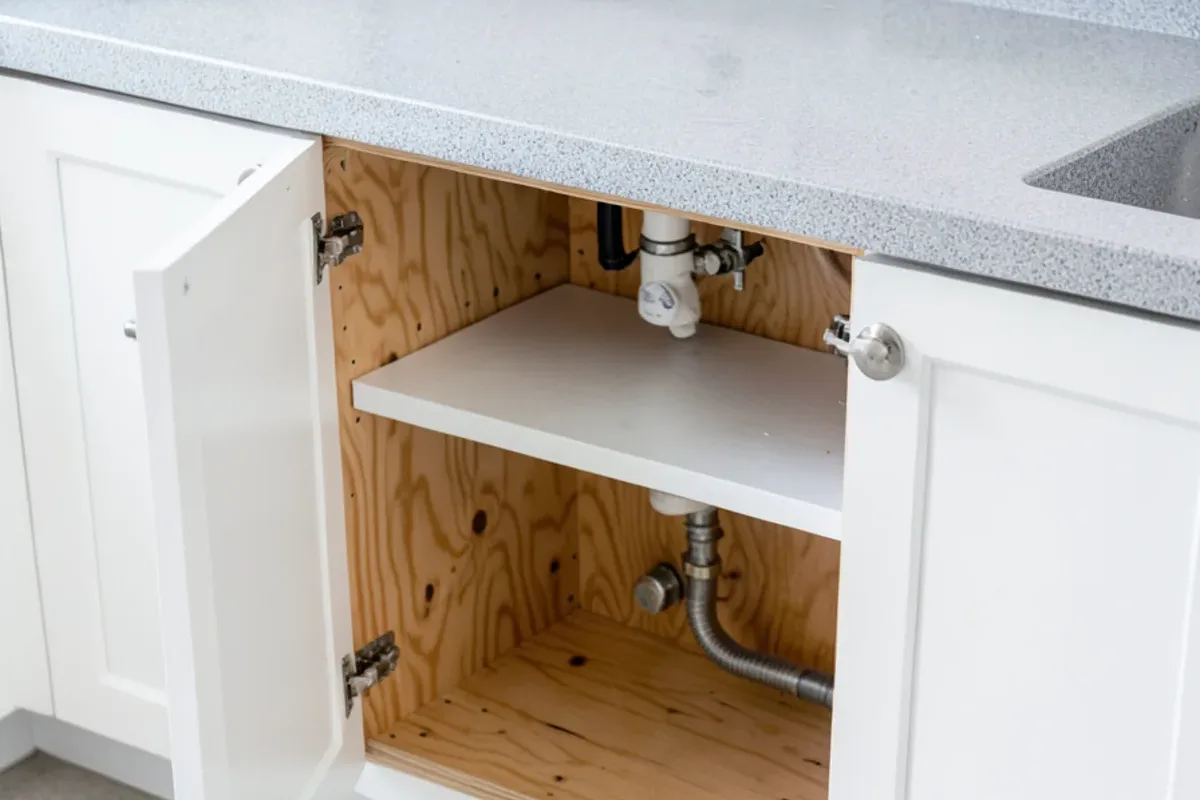
- Plywood sink base. Particleboard swells after one slow drip under the faucet; plywood holds its shape and its screws.
- Standard cabinet sizes and one door style. A stock Shaker or flat door in a common color is easy to reorder when one front gets damaged.
- Painted or laminate doors over thermofoil near heat. Thermofoil can lift beside ovens and toasters, which shows up at move-out.
- Prefab granite or quartz tops. Both resist knife marks and hot-pan rings better than laminate, and prefab lengths keep the cost close to a laminate counter in many small kitchens.
- Simple hardware. Bar pulls in a standard hole spacing are easy to replace one at a time.
How do you shorten the turnover window?
Vacancy days cost more than most finishes. The fastest turnovers follow the same order every time:
Walk the unit the day it is vacated
Photograph each room, open every cabinet, check under the sink and note floor damage by room and square footage.
Order materials before work starts
Flooring, replacement doors and any counter should be ordered from your spec sheet right away; ask for the expected arrival date when you order.
Fix water issues first
Leaks under sinks, around toilets and at the dishwasher get a plumber before anything new is installed.
Paint, then cabinets and counters
Painting before new floors avoids drips on fresh planks.
Install flooring last
Floors go in after the messy trades are finished, followed by a final clean and photos for the listing.
What wears out first? A move-out inspection guide for kitchens and floors
The walk-through on move-out day decides the whole turnover budget. These are the spots that fail first in a rental kitchen and on its floors, and how each one is usually handled:
| Check | What to look for | Usual fix |
|---|---|---|
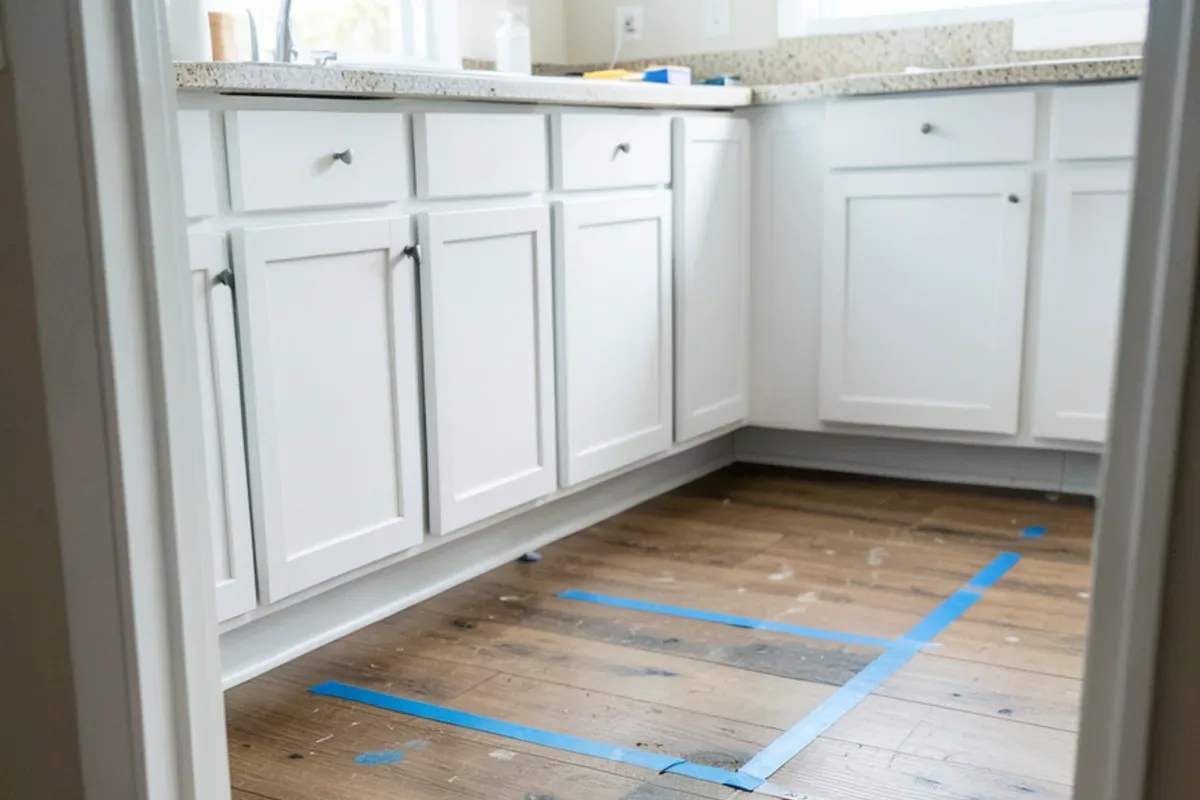
| Floor in front of the sink and dishwasher | Soft spots, lifted plank edges, dark stains at seams | Find and fix the leak, then replace planks; check the subfloor if it feels spongy |
| Traffic lanes and the entry | Dull path where the wear layer is gone | Replace the worn planks from spare stock, or the room if wear is widespread |
| Sink base cabinet | Swollen bottom panel, rust rings, mildew smell | Replace the floor panel or the whole base with plywood |
| Cabinet doors and hinges | Sagging doors, screws spinning in stripped holes | Re-drill or replace hinges; replace a door from the standard line |
| Countertop edges and seams | Chips beside the dishwasher and range, open seams | Professional chip repair for stone; replace a damaged prefab section |
| Caulk at sink, backsplash and floor edges | Gaps, mildew, peeling | Cut out and recaulk before new tenants move in |
Write each finding against the unit’s spec sheet, with square footage for any floor work, so materials can be ordered the same day the inspection is done.
Standardize once, repair for years
Owners with several units save the most by writing down exactly what went in: floor product and color, cabinet line and door color, counter material and edge, grout color, paint codes. When the next tenant moves out, that sheet turns a design decision into a reorder.
Keep spare stock as well. Two or three extra boxes of flooring from the original order, stored flat in a dry place, mean a damaged plank can be replaced with one from the same production run, which matches better than a box bought years later.

Patterns seen on the showroom floor with landlords
Property owners who compare materials side by side tend to land on similar choices, and the reasons are practical rather than stylistic:
- Mid-tone, matte floors win. Very dark planks show dust and paw prints; very light ones show grime in traffic lanes.
- Carpet stays in some bedrooms. Carpet comes at every price level, and a modest grade in bedrooms over vinyl in living areas keeps the budget balanced.
- Counters and floors are picked together. Seeing a prefab top beside the floor sample avoids a busy granite clashing with a busy plank.
- Quotes get compared line by line. According to Google reviewers, competing quotes get matched within reason, so bring other bids with the same scope written out.
One trade-off deserves a straight answer. Click-lock vinyl floats and goes in fast, but replacing a plank in the middle of a room means unclicking rows from the nearest wall or cutting the plank out and gluing in a replacement. Glue-down vinyl makes single-plank swaps simpler and suits units with heavy rolling loads, but it takes longer to install and much longer to tear out later. Owners who turn units often tend to choose based on which repair they expect to make most.
How do floor records help with deposits and normal wear?
Floors are one of the most common sources of disagreement at move-out, because the line between ordinary wear and damage is easy to argue. California’s security deposit law (Civil Code section 1950.5) lets a landlord deduct for damage beyond ordinary wear and tear, and requires an itemized statement within 21 days of move-out, with receipts or invoices for larger repair charges.
Since 2025, state law (AB 2801) has also asked landlords to photograph the unit at move-out, before and after repairs, and at the start of new tenancies. Good flooring records make all of this simpler:
- The install date and product for each room, so the age of a worn floor is clear.
- Dated photos of every room at move-in and move-out, taken from the same corners each time.
- The wear layer thickness from the product sheet, which shows how long the floor was expected to last in traffic.
- Invoices for any plank replacement, matched to the room and the cause.
This is general background, not legal advice. For a specific dispute, the Los Angeles Housing Department or a landlord-tenant attorney is the right place to ask.
What rules apply in older LA and Inglewood rentals?
Many rental buildings in Los Angeles and Inglewood were built before 1978. Under the EPA’s Renovation, Repair and Painting (RRP) rule, paid work that disturbs more than 6 square feet of painted surface inside a pre-1978 unit must be done by an EPA-certified firm using lead-safe practices. Pulling old cabinets or baseboard counts.
Moving plumbing or electrical needs a permit from the right authority: LADBS for City of Los Angeles units, Inglewood’s building division for addresses there. If tenants remain in a rent-stabilized City of LA unit during work, the Los Angeles Housing Department has its own requirements, so check them first. Inglewood is about 33 minutes (24 miles) from the North Hollywood showroom; the Los Angeles service area page covers neighborhoods across the city.
Rental renovation pages to read next
The rental renovation page covers cabinets, counters, tile and flooring for single units and small buildings, and the waterproof vinyl flooring page goes deeper on the floor most landlords choose. Buy materials only for your own crew, or have the products you pick installed on request.
Quick answers
How much extra flooring should a landlord keep on hand?
Keep at least two or three full boxes beyond what the install used, or roughly 5 to 10 percent of the area, from the same production run. Store them flat indoors, away from garage heat. When a plank is gouged or water-stained at the next turnover, the spare will match far better than a box bought years later.
Is carpet still worth using in rental bedrooms?
It can be. Carpet is quiet, warm and inexpensive to install per room, which matters in upstairs units where neighbors hear footsteps. Expect to replace it more often than vinyl, and keep it out of kitchens, baths and entries. Many owners use waterproof vinyl in living areas and a modest carpet grade in bedrooms.
Does waterproof vinyl hold up to pets in a rental?
Generally yes. The core does not swell from accidents or water bowls, and a thicker wear layer resists claw scratches better than a thin one. Pick a textured, mid-tone plank so light scratches blend in. If one plank is damaged, a click-lock floor lets an installer swap that section without lifting the room.
Do landlords need a lead-safe firm for work in older rentals?
If the unit was built before 1978 and the paid work disturbs more than 6 square feet of interior paint, the EPA’s RRP rule requires a certified firm and lead-safe work practices. That covers common turnover tasks like removing cabinets, trim or old flooring glued to painted surfaces. Ask any contractor for their EPA firm certification.
Sources
- U.S. EPA: Lead Renovation, Repair and Painting Program — Lead-safe rules for paid work in pre-1978 housing
- Los Angeles Housing Department (LAHD) — Rules for rent-stabilized units in the City of Los Angeles
- Los Angeles Department of Building and Safety (LADBS) — Permits for City of Los Angeles properties
- California Legislative Information: Civil Code §1950.5 — Security deposit rules, including normal wear and tear and the 21-day itemization
About this guide
Written by the team at Adcom Kitchen & Flooring, a kitchen cabinet, countertop, tile and flooring showroom at 13259 Sherman Way in North Hollywood. Rules and figures from outside sources are attributed; confirm current requirements with your building department or the agency named.
Related services
Service areas
More on this topic: Home Remodeling
Talk to the showroom before you buy
Call with your measurements and photos, or stop by Sherman Way to compare cabinets, counters, tile and flooring side by side.
Adcom Kitchen & Flooring · 13259 Sherman Way, North Hollywood, CA 91605 · Get directions · Showroom hours
- Showroom at 13259 Sherman Way, North Hollywood
- 20 Google reviews
- BBB rating A+
- Cabinets, counters, tile & floors in one place